

Happy Tuesday! In Q3, one firm, Bessemer, raised the biggest haul: $5.75 billion. The Q3 2026 PitchBook-NVCA Venture Monitor shows US venture funds have raised more this year than in all of 2025. Murph Capital's State of VC Fundraising: Q3 2026 tracked the 152 funds that closed globally last quarter. Read together, they tell the same story. Fundraising is back, but the money is going to fewer and bigger managers. Here is who raised, who did not, and who is writing the checks. Let's dive in!
Brought to you by:
Pliancy - Experience the freedom of IT that just works. Partnering with Pliancy means regaining the time & energy to focus on your mission—without having to worry about the day-to-day tech that makes it possible. Discover why VC firms from coast to coast choose Pliancy (or ask about us in VCBC).
Standard Metrics - Munich Re Ventures’ finance manager wanted to map every co-investor relationship across their portfolio. With clean, structured data already available through Standard Metrics, the team used Claude to build a network graph in under 10 minutes. See what else they built.
Airstream Alpha CFO - Modern CFO support for venture funds and investment firms. With 50+ CFO mandates, Airstream Alpha brings structured, tech-forward oversight and guidance to fund finance, from reporting and compliance to service-provider coordination, so partners stay focused on investing and LP relationships. Learn how funds work with Airstream Alpha from first close through scale.
1️⃣ Money Is Up, Managers Are Down
What the data shows:
US venture funds raised $108.5 billion across 699 funds through Q3, according to PitchBook. That is already 38.6% more than the $78.3 billion raised in all of 2025.
Funds of $500 million or more took 78.1% of that capital. They were just 6% of the funds that closed.
Andreessen Horowitz alone closed $23.8 billion this year, more than 20% of all US venture capital raised.
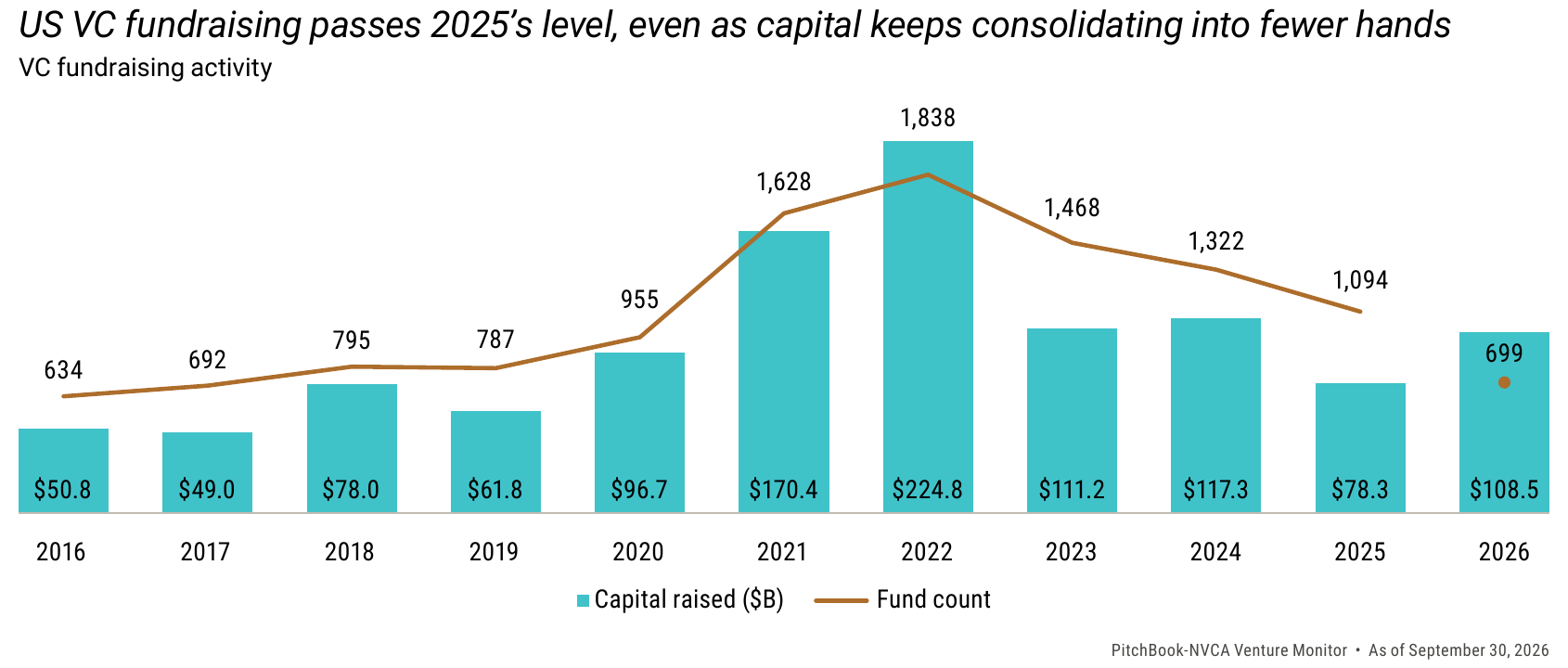
What this means: The headline looks like a recovery. One layer down, most of the money sits with a small group of very large platforms.
2️⃣ Mega Funds Took the Quarter
What the data shows:
Murph tracked 152 funds that announced a close in Q3, raising $46 billion, up from 137 funds and $39.3 billion in Q2.
26 funds of $500 million or more raised $35.1 billion, or 76% of the quarter’s capital. In Q2, only 15 funds cleared that bar.
Bessemer’s $5.75 billion came in a single close: $1.75 billion for seed and early stage, and $4 billion for growth. That puts about 70% of the dollars into growth, even though Bessemer says roughly 70% of its investments are made at the early stage. Its reason is that companies are staying private longer and creating more of their value before they go public. The total outraised all 86 emerging funds combined, and the growth fund alone nearly matches them ($4 billion vs. $4.23 billion).
Three things drove the biggest raises: AI markups, real exits like Index Ventures’ Wiz payout, and a shift to growth and secondaries products. 12 of the 26 mega funds are growth, secondaries or co-investment vehicles.
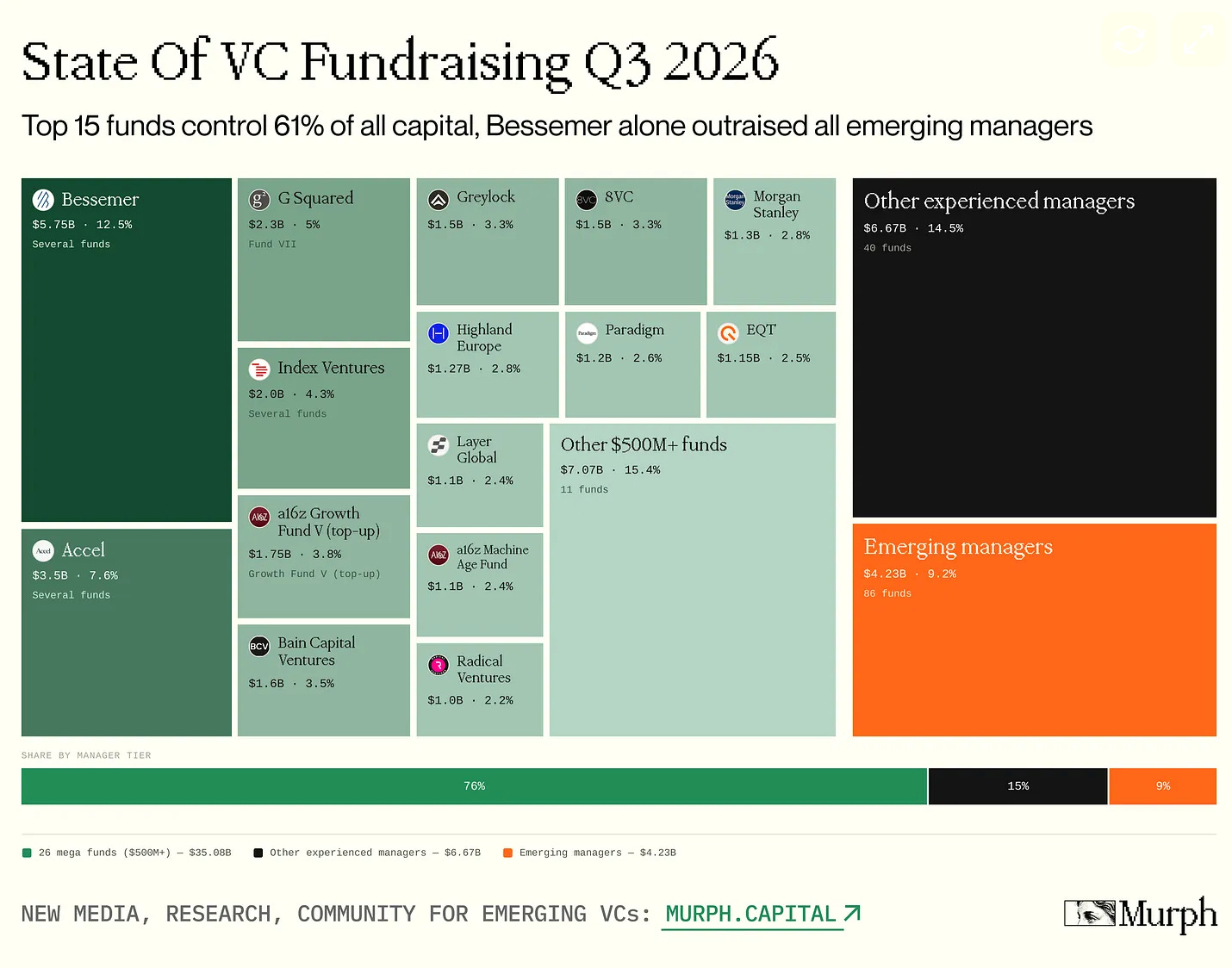
What this means: The largest managers are raising on proof. They have paper gains to show or cash to point to, and LPs are rewarding both. Even firms known for early-stage investing are putting most new dollars into growth, because that is where companies now spend the most time.
3️⃣ “Average” Is Misleading
What the data shows:
In the US, the average fund rose 87.2% to $165.4 million this year, the second-highest level in a decade, per PitchBook. The median fell for a fifth straight year, to $10 million.
Funds of $100 million to $500 million made up about 17% of US closes before 2021. Through Q3 2026, they are 10%, the lowest on record.
Murph’s global data shows the same gap. The median Q3 close was $71 million against a $319 million mean. Only 31 of 144 funds with a disclosed size raised above the mean.
The two medians differ because PitchBook counts every US fund, including very small ones, while Murph counts publicly announced closes worldwide.
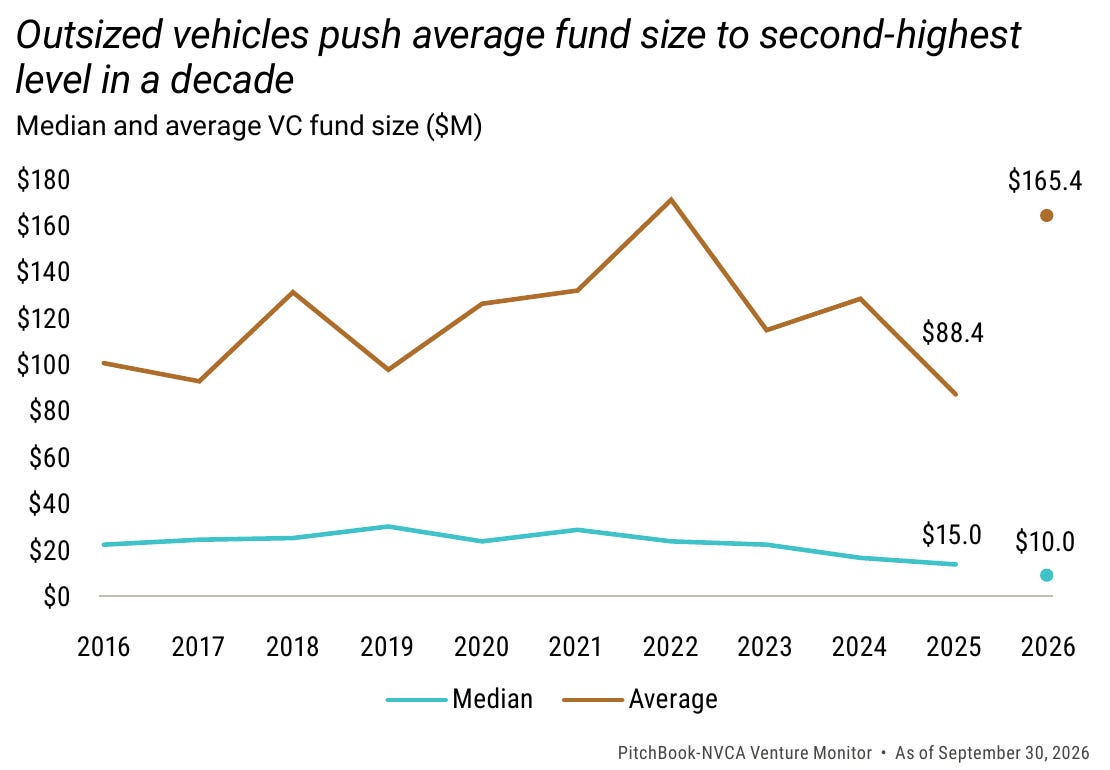
What this means: A few giant funds pull the average up while most funds get smaller. PitchBook describes midsize managers as squeezed from both sides. They are too big to move as fast as small seed funds, and too small to write the checks AI companies now need.
4️⃣ Emerging Managers Are Squeezed, and They Back Different Sectors
What the data shows:
In Murph’s data, 86 emerging funds (Fund I or II, under $250 million) made up 57% of Q3 closes. They raised just 9% of the capital, down from 13% in Q2. Their median close fell to $31 million from $55 million.
Emerging managers invest where the platforms do not. Climate is 18% of emerging dollars versus 2% of the market. Defense is 10% versus 3%.
In the US, the number of emerging firms closing at least one fund fell from 927 in 2022 to 211 through Q3 2026, per PitchBook. First-time funds raised $4.9 billion across 81 funds.
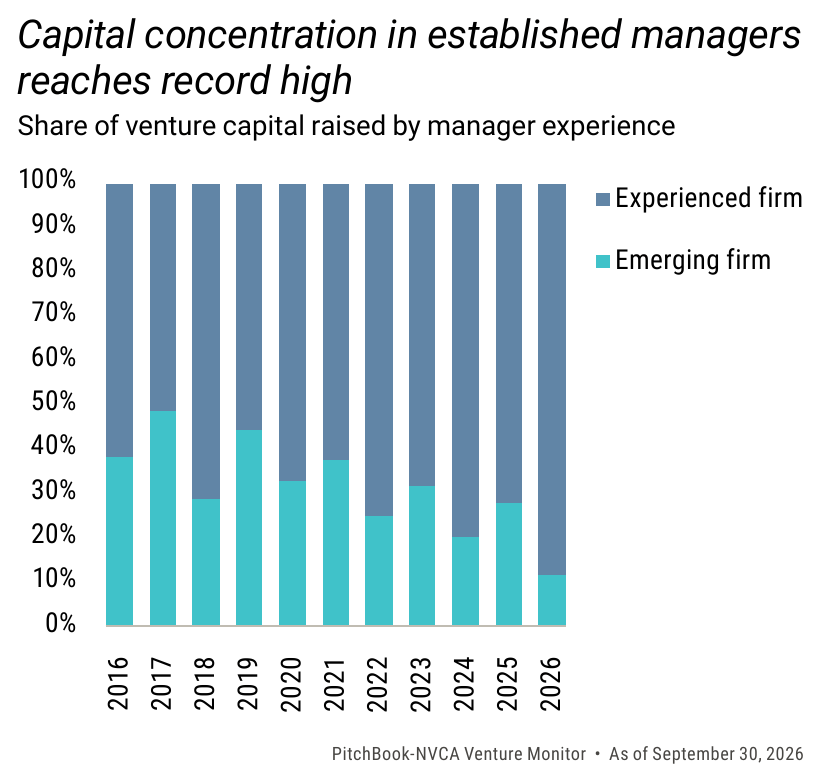
What this means: Raising a first or second fund is the hardest it has been in years. The managers who do close tend to have a sharp sector focus, not a generalist pitch. If you are raising a first or second fund, budget for a longer raise and a smaller first close than you would have planned in 2021.
5️⃣ Who Backs Them
What the data shows:
83 of Murph’s 152 funds named at least one LP.
Development finance institutions (government-backed investors like the European Investment Fund) were the most common LP type, backing 41 of those 83 funds. Almost all of their commitments went to funds outside the US.
Of 351 named LPs, only 16 backed more than one fund in the quarter.
Mega funds rarely disclose LPs. Only 8 of the 26 named a single LP.
PitchBook ties the concentration to liquidity. LPs who get cash back from a proven manager tend to recommit it to that same manager.
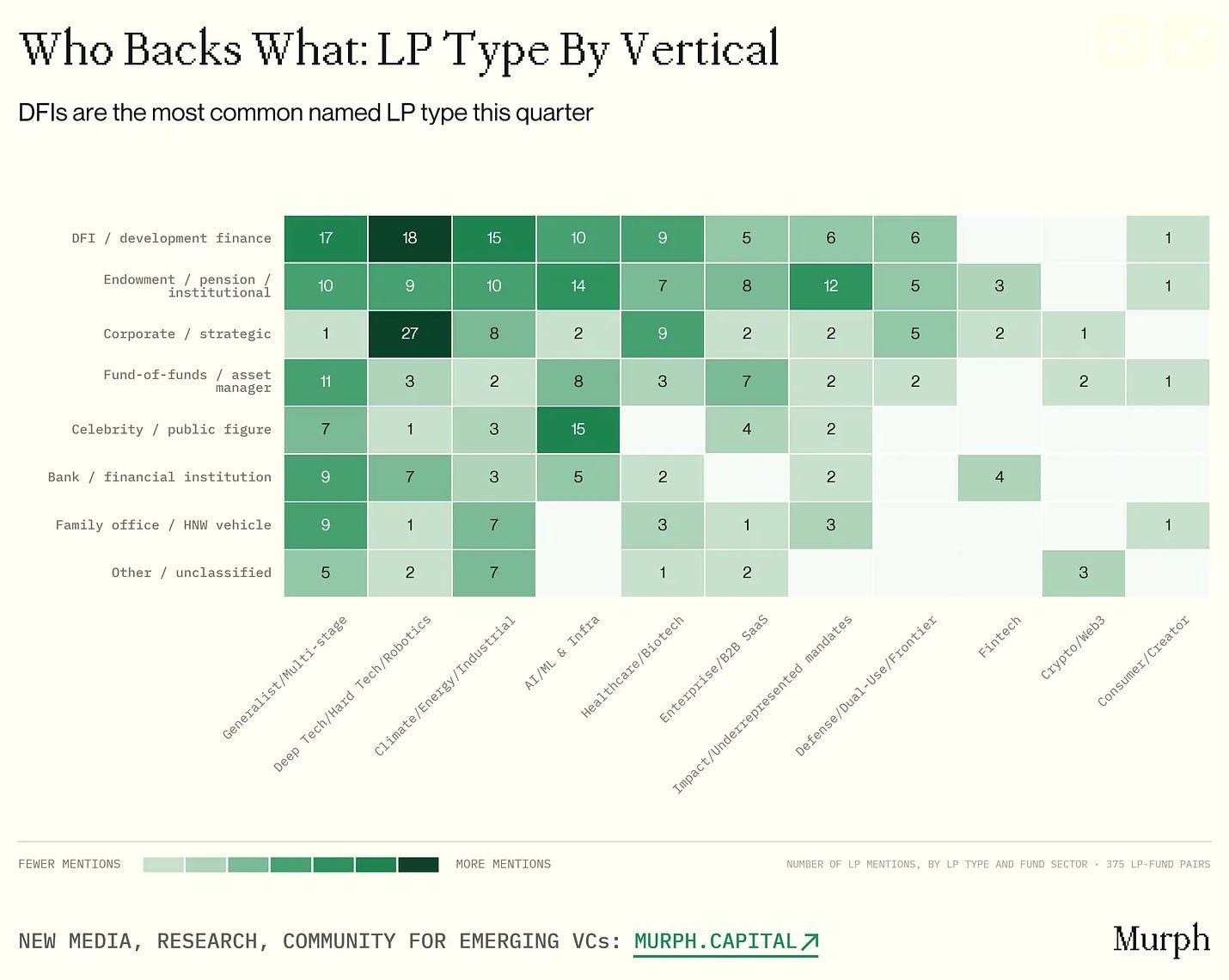
What this means: Distributions decide who gets the next commitment. If you are raising, your DPI story matters more than your markups (see #359: DPI in 2026 vs. $1 Trillion in NAV and #373: What’s Driving Venture DPI?). Outside the US, a development bank may be a more realistic first LP than a US endowment.
Final Takeaways
Money is up: US funds raised $108.5 billion through Q3, with 78.1% going to funds of $500 million or more.
Mega funds: 26 funds took 76% of Q3 capital, and Bessemer alone outraised all 86 emerging funds.
Average is misleading: The middle is disappearing. Funds of $100 million to $500 million are now 10% of US closes.
Emerging managers: They raised 9% of Q3 capital and are winning in sectors the platforms skip, like climate and defense.
LPs: Public capital backs emerging funds outside the US, and LPs re-up with managers who return cash.
Bottom Line: Venture fundraising is recovering, but only at the top. For emerging and midsize managers, the path is a sharp focus and a realistic timeline. Clear proof of liquidity matters most. As we covered in #377, distributions are still the market’s bottleneck, and they decide who raises next.
If you are planning your next raise and want help with LP reporting or fund operations, learn more about Airstream Alpha CFO support.
That’s all for today folks! Thanks for your support and spreading the word! Share this on X or LinkedIn to help grow “the crew!”
Every Tuesday/Thursday, we publish VC/CFO insights that matter - highlights from notable VC GPs, LPs, and CFOs/finance pros. Check out our VC Fund Playbooks, Models, Budgets, & Compliance Checklists @ AirstreamAlpha Products!
Need more help? Check out Fund CFO Support provided by the Airstream Alpha Team.
Love what we’re doing? Consider upgrading to paid for deeper dives on Thursdays (most paid subscribers expense these insights!). Top recent posts: