
#361: Rethinking VC Reserves
Happy Tuesday! You’ve probably heard the rule: keep 3 to 6 months of expenses in reserve before you invest a dollar more. Conventional wisdom, rarely questioned. Now imagine the person who taught you that rule just said it’s doing more harm than good.
That’s what just happened in venture. For over a decade, early-stage funds have reserved 40 to 50% of the fund for follow-ons, doubling down on winners. In the past week, Hunter Walk, co-founder of Homebrew, publicly said he was wrong about it, and this month’s PitchBook-NVCA Venture Monitor shows exactly why the timing isn’t a coincidence.
Brought to you by:
AngelList - As VC firms scale their institutional LP base, finance is no longer just back-office hygiene—it’s a strategic advantage. AngelList’s fund admin operates like an outsourced COO, streamlining operations, meeting institutional diligence standards, and delivering timely, accurate reporting. See why 25k funds and syndicates trust AngelList.
Pliancy - Experience the freedom of IT that just works. Partnering with Pliancy means regaining the time & energy to focus on your mission—without having to worry about the day-to-day tech that makes it possible. Discover why VC firms from coast to coast choose Pliancy (or ask about us in VCBC).
Standard Metrics - Structured portfolio data and LLMs are enabling VC firms to automate portfolio reporting, from tear sheets to valuation memos. Explore 17 workflows that modern fund teams are automating with AI.
Airstream Alpha CFO - Modern CFO support for venture funds and investment firms. With 50+ CFO mandates, Airstream Alpha brings structured, tech-forward oversight and guidance to fund finance, from reporting and compliance to service-provider coordination, so partners stay focused on investing and LP relationships. Learn how funds work with Airstream Alpha from first close through scale.
1️⃣ The Old Rule: Reserve 40-50%, Then Double Down on Winners
For over a decade, this wasn’t even a debate. It was just how you built a fund model.
The conventional playbook, unchanged for years, as Carta’s own fund-management guidance still lays out today:
Reserve 40 to 50% of total fund size for follow-ons, the number nearly every LPA and fund model template still defaults to.
Hold that capital back specifically to protect ownership and “double down” on the handful of companies that end up carrying the fund’s returns.
Treat the reserve line as fixed at close, not something you revisit as market conditions shift.
What this means for you: if your fund model has a reserves line sitting at 40-50% because that’s what the template said to do, you’re not wrong exactly, you’re just running on assumptions that were set over a decade ago, before the market looked anything like it does now.
2️⃣ Why a 13-Year Homebrew Veteran Just Reversed Himself
On July 23, Hunter Walk, co-founder of Homebrew, published a post arguing that early-stage funds of $100M or less should hold almost no reserves for follow-on. Not trim them. Almost none.
What he’s walking back, point by point:
Picking insight is weaker than it used to be. Follow-on rounds now happen weeks or months after the initial check, with far less real signal on which companies are actual outliers versus just quick out of the gate.
Pro rata “advantage” often isn’t one anymore. Crowded cap tables and founders under pressure from new lead investors mean smaller funds increasingly get squeezed out of their own pro rata, or pressured to skip it to reduce dilution.
Pricing discipline has broken down. Multistage firms with billions to deploy are underwriting to lower return targets and competing to get into hot rounds. Walk describes the dynamic as looking more like an auction than a valuation.
The historical data backing “always do your pro rata” is stale. The market has changed too much in the last 5 to 10 years for those old backtests to still hold.
What this means for you: if you’re holding 40-50% in reserve because “that’s what strong funds do,” the person who helped popularize that instinct is now telling you to check whether the assumptions underneath it still apply to your fund, not just follow the number.
Would your reserve strategy survive being asked “why,” line by line, the way Walk just did to his own?
3️⃣ The Market Backdrop That Makes This Argument Land
Walk’s post isn’t happening in a vacuum. It lines up with exactly what this month’s market data shows.
What the data shows:
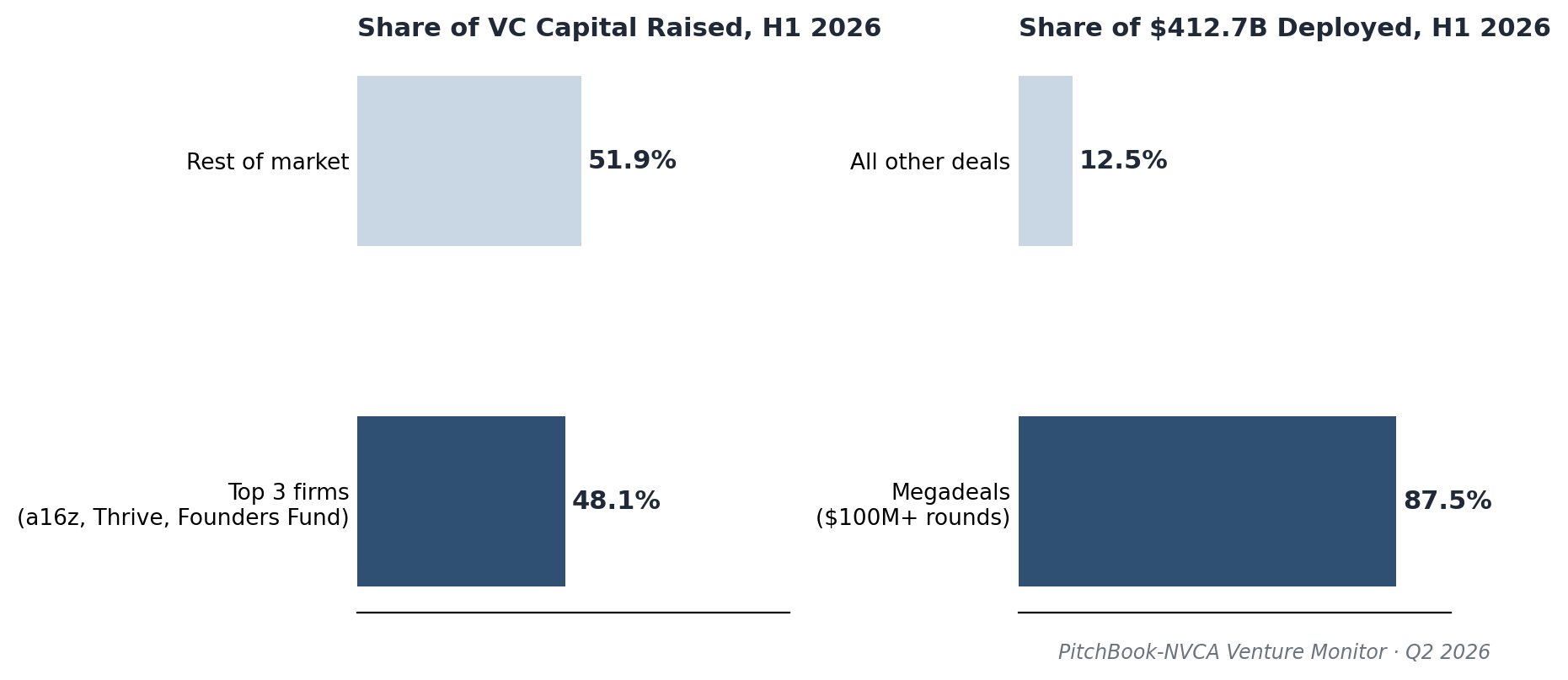
The Q2 2026 PitchBook-NVCA Venture Monitor found three firms, Andreessen Horowitz, Thrive Capital, and Founders Fund, took in 48.1% of all venture capital raised in H1 2026.
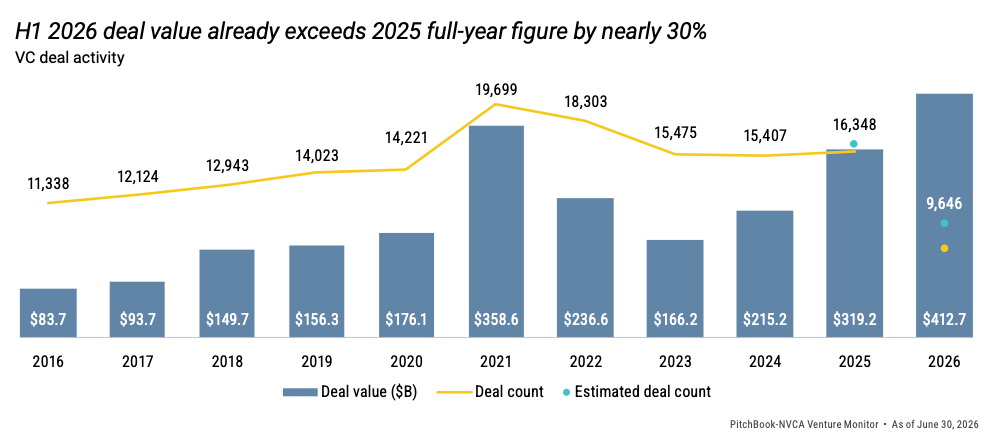
Megadeals of $100M or more captured 87.5% of the $412.7 billion deployed in the same period
That’s the exact environment Walk describes: smaller funds competing for follow-on allocation against firms with vastly more capital and a higher risk tolerance for overpaying to get in.
What this means for you: if you’re a smaller fund assuming your pro rata will be there when you want it, this is the data that says you should stress-test that assumption before you build your reserve strategy around it.
4️⃣ The Option Between “Reserve Everything” and “Reserve Nothing”
Walk’s post reads like a binary: reserve heavily or don’t. But there’s a third lever that’s easy to miss, recycling.
What the data shows:
Recycling provisions in an LPA let a GP reinvest proceeds from an early exit back into new deals, typically limited to the fund’s active investment period and capped at 20-25% of total commitments.
Walk mentions Homebrew got to 120%+ invested in each of its first two funds by using recycling, effectively expanding capital availability without holding a large passive reserve pool the whole fund life.
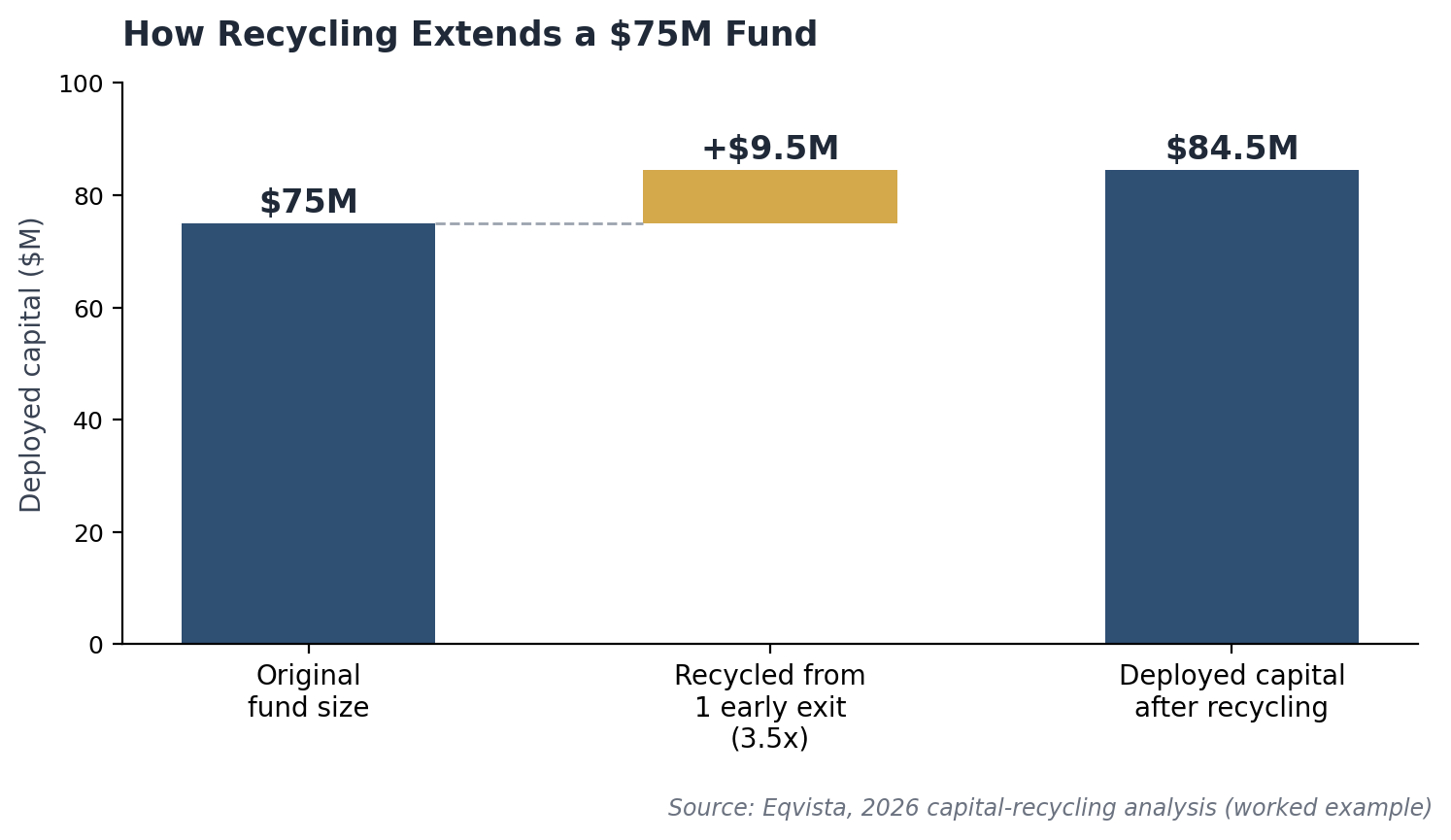
Eqvista’s 2026 analysis walks through why now: Fed rate stabilization has cut the opportunity cost of reinvesting versus parking capital, secondary-market liquidity has improved enough that GPs can source early exits to recycle, and SEC RIA disclosure rules have tightened around reporting recycled-capital flows. In their worked example, a $75M fund that recycles $9.5M from one early 3.5x exit pushes deployed capital to $84.5M with no new LP commitment, and roughly $28.5M in added gross proceeds if the recycled bets perform at 3x.
What this means for you: before you treat “reserves vs. no reserves” as the only decision, check what your LPA actually allows on recycling. It may be the tool that lets you follow Walk’s advice without leaving your LPs’ expectations about follow-on capacity unmet.
5️⃣ A Framework You Can Actually Use This Week
Walk offers a simple gut-check for any follow-on decision, worth stealing directly.
What the data shows:
You believe in the company as much as the market does. The round is fairly priced and you see real growth ahead. Do your pro rata from the fund, no SPV needed.
You believe in it less than the market does. The terms are aggressive relative to your own conviction. Skip your pro rata, or route interested LPs into an SPV instead of fund capital.
You believe in it more than the market does. This is where a few hundred thousand to a couple million extra dollars, deployed ahead of an inflection point, can meaningfully change your ownership and your fund’s outcome.
What this means for you: the question isn’t “do I have reserves left.” It’s “does this specific company, at this specific price, earn new capital compared to every other use of that same dollar.” That’s a different, sharper question than most fund models are built to ask.
Final Takeaways
The 40-50% reserve rule that’s in most fund models and LPAs was built on assumptions from over a decade ago, and one of its earliest champions just publicly walked it back.
Crowded cap tables and mega-fund competition mean smaller funds can no longer assume their pro rata will be honored the way it used to be.
This month’s market concentration data (3 firms, 48% of capital) is the real-world backdrop making that argument land.
Recycling is the underused middle option between “hold a big reserve” and “hold none.”
The sharper question isn’t how much you’ve reserved. It’s whether this specific follow-on beats every other use of that same dollar.
Bottom Line: Reserves were never supposed to be a passive line item, they were supposed to be a decision, made fresh every time, about where your next dollar does the most good. The market that built the 40-50% rule doesn’t exist anymore. So here’s the one worth sitting with: is your fund still reserving on autopilot, or actually deciding?
That’s all for today folks! Thanks for your support and spreading the word! Share this on Twitter or LinkedIn to help grow “the crew!”
Every Tuesday/Thursday, we publish VC/CFO insights that matter - highlights from notable VC GPs, LPs, and CFOs/finance pros. Check out our VC Fund Playbooks, Models, Budgets, & Compliance Checklists @ AirstreamAlpha Products!
Need more help? Check out Fund CFO Support provided by the Airstream Alpha Team.
Love what we’re doing? Consider upgrading to paid for deeper dives on Thursdays (most paid subscribers expense these insights!). Top recent posts: