
Happy Thursday! Today we’re going deep into SVB’s State of the Markets: H1 2026. Every six months, SVB shares data around fundraising, investments, and exits across venture. What are the key takeaways? We break them down below!
Brought to you by:
Visible - No more chasing founders or wrangling spreadsheets. Finance teams at top VC firms use Visible’s AI-driven platform to streamline portfolio monitoring, stay audit-ready, and impress LPs. Find out why our customers love us today.
AngelList - As VC firms scale their institutional LP base, finance is no longer just back-office hygiene—it’s a strategic advantage. AngelList’s fund admin operates like an outsourced COO, streamlining operations, meeting institutional diligence standards, and delivering timely, accurate reporting. See why 25k funds and syndicates trust AngelList.
Pliancy - Experience the freedom of IT that just works. Partnering with Pliancy means regaining the time & energy to focus on your mission—without having to worry about the day-to-day tech that makes it possible. Discover why VC firms from coast to coast choose Pliancy (or ask about us in VCBC).
$340B Invested in 2025 (Concentrated in Mega-Deals)
What the data shows:
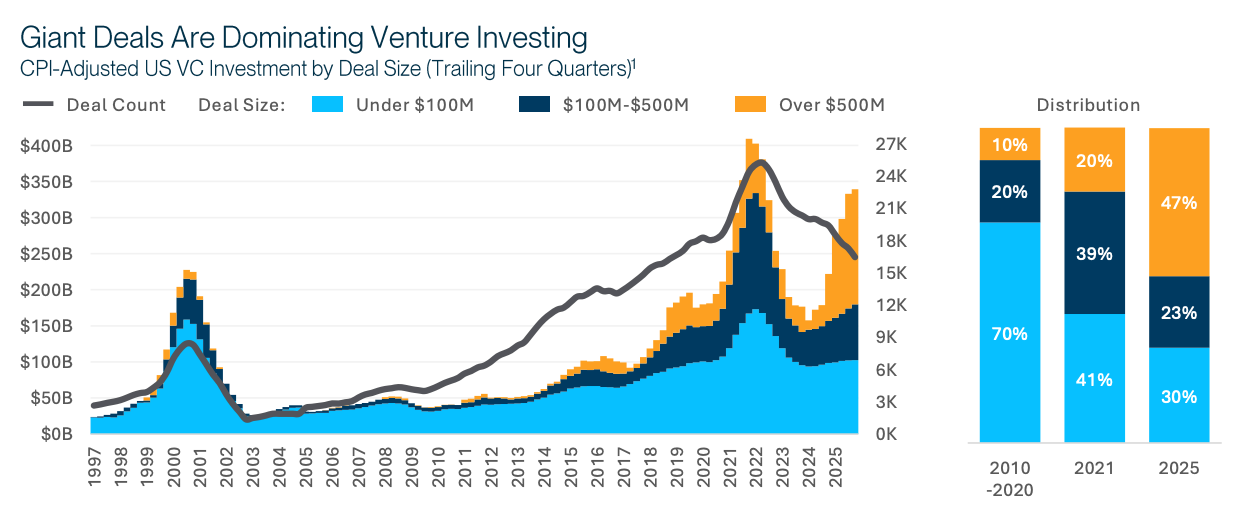
Roughly $340B was invested in US VC-backed companies in 2025, the second-strongest year on record
Nearly half of that capital went into rounds of $500M or more
Twenty-four companies raised billion-dollar VC rounds
Capital was deployed across the fewest deals of the 2020s
Valuations and capital levels that were once reserved for public markets are now possible, or even expected, for the top private companies. Deals of this scale differ from the risk and return profiles traditionally associated with early-stage venture.
What this means:
A growing share of venture capital is being deployed into a small number of very large rounds. Large deal sizes and lower deal count means that the large rounds matter more. But can these large deals at higher valuations generate the returns that venture capital funds need to deliver to their investors? Time will tell.
$4.4T Is Locked in Private Unicorns, With Higher Revenue Requirements at Each Stage of Funding
What the data shows:
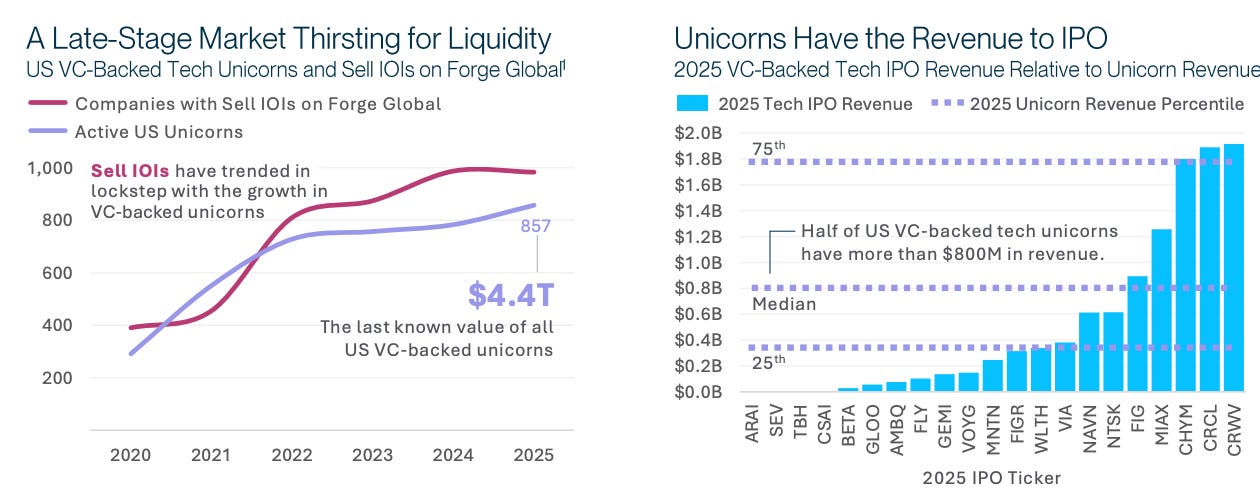
Approximately $4.4T of value is held in US private unicorns
About half of US VC-backed tech unicorns exceed $800M in revenue
These revenue levels exceed historical IPO benchmarks
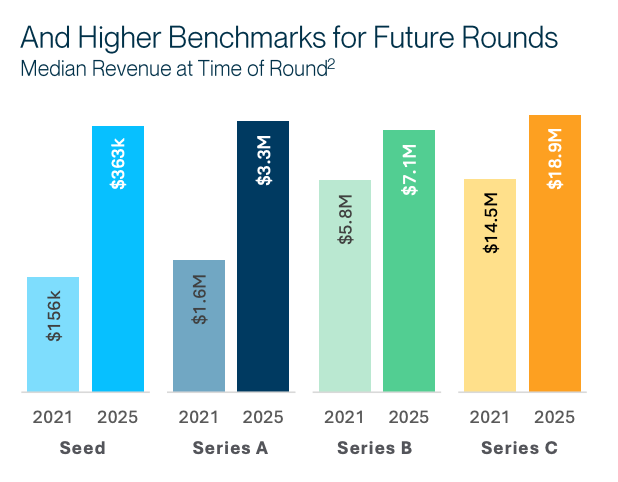
At the earlier stages of the market, the revenue required to raise capital has increased across stages since 2021:
Seed: ~$156K to ~$363K
Series A: ~$1.6M to ~$3.3M
Series B: ~$5.8M to ~$7.1M
Series C: ~$14.5M to ~$18.9M
SVB notes that higher benchmarks to raise, combined with slower growth, have contributed to lower graduation rates and an increase in extension rounds.
What this means:
A significant amount of company value is remaining private for longer. Even companies with revenue levels that would have supported an IPO in prior cycles are staying private as fundraising and exit thresholds have moved.
Higher revenue requirements earlier in the company lifecycle are slowing progression between rounds. As a result, more companies rely on extension rounds to maintain runway, and fewer companies advance quickly to later stages or liquidity events.
AI Capital Matches the Dot-Com Era (Concentrated in Five Companies)
What the data shows:
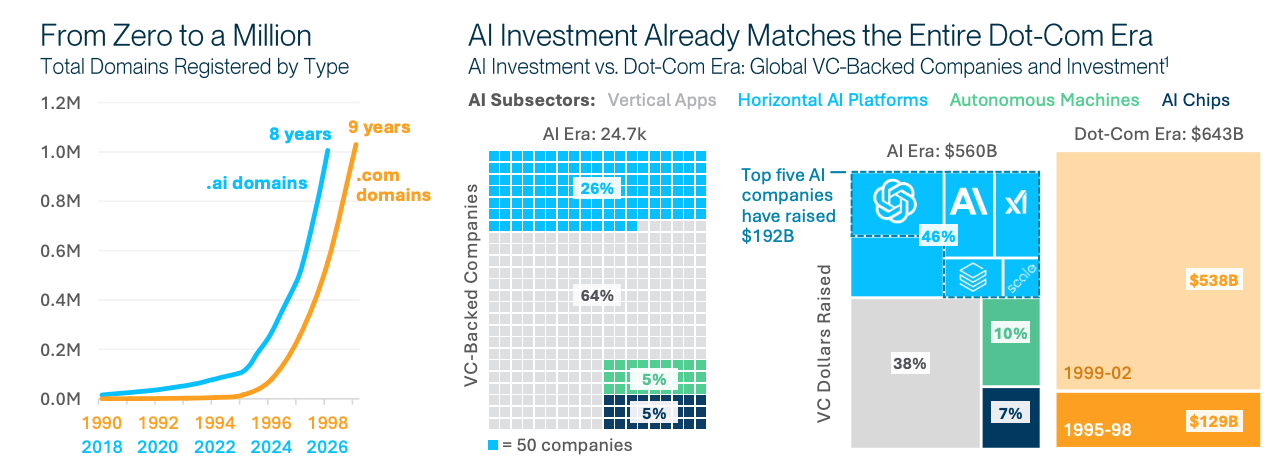
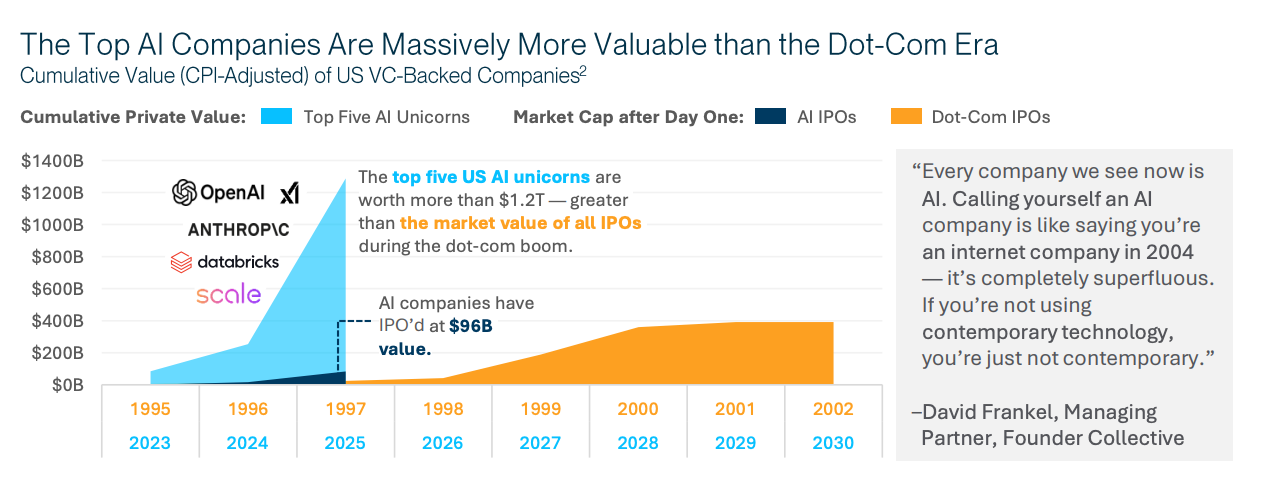
Global AI venture investment totals $560B, comparable to the entire dot-com era in inflation-adjusted dollars
Five companies received roughly one-third of total AI venture funding: OpenAI, Anthropic, xAI, Databricks, Scale AI
Horizontal AI platforms represent about one-quarter of AI startups and received close to half of AI investment
SVB illustrates the small group of companies accounting for a large share of total AI funding in a few charts below.
What this means:
AI investment is concentrated in a few companies. These select few have become increasingly important to the venture funds that back them and the industry.
🎯 Tools for Decision-Making in a More Selective Market
As outcomes continue to diverge across and within portfolios, many GPs are pressure-testing deployment pace, ownership targets, reserve strategy, and the timing of DPI under different scenarios. The tools below are ones we use internally to evaluate these decisions in a structured, repeatable way — helping teams see how concentration, dilution, and exit timing actually affect fund outcomes, not just headline valuations.
