

Shout out to our friend Mike Witkowski (CFO @ Eniac) for his generous contributions to in this post!
As 2025 wraps up, one theme cuts across nearly every VC and LP conversation: the liquidity drought. Fundraising cycles are slower, pacing has tightened, continuation vehicles are more common, and hold periods have extended well beyond historical norms. These dynamics have reshaped how managers think about reserves, DPI, and exit planning. In this post, we dive deeper into one mechanism that actually resets liquidity cycles: public markets.
And despite the persistent “window is closed” narrative, companies are getting out. The bar has simply become much higher—more selective, more size-driven, and more narrative-dependent. Below is a clear view of what’s actually making it through the IPO gate in 2025, and why.
Brought to you by:
Visible - No more chasing founders or wrangling spreadsheets. Finance teams at top VC firms use Visible’s AI-driven platform to streamline portfolio monitoring, stay audit-ready, and impress LPs. Find out why our customers love us today.
AngelList - As VC firms scale their institutional LP base, finance is no longer just back-office hygiene—it’s a strategic advantage. AngelList’s fund admin operates like an outsourced COO, streamlining operations, meeting institutional diligence standards, and delivering timely, accurate reporting. See why 25k funds and syndicates trust AngelList.
1. The IPO Window Isn’t Closed — It’s Filtered
Across market participants, the message this year has been consistent:
IPO activity hasn’t stopped, but it is consolidating around a narrow set of profiles.
The patterns we see across deals:
Companies with credible AI adjacency or infrastructure exposure are getting real attention.
Offerings in the $5B+ range are finding stronger institutional demand.
Sub-scale listings — especially below ~$3B — face valuation pressure and mixed aftermarket performance.
This isn’t about enthusiasm; it’s about liquidity, indexability, and investor concentration.
Source: Renaissance Capital 2025 IPO Market Stats
2. The 2025 IPO Funnel: Large, AI-Linked, and Sparse in the Middle
The IPO market in 2025 is rewarding a specific set of attributes:
What’s getting through:
AI infrastructure and AI-enabled software
Enterprise companies with clear growth visibility
Offerings priced in the $5B–$15B+ range
Businesses with clear crossover/institutional support
What’s struggling:
SaaS companies without a differentiated AI leverage point
Vertical SaaS with slower expansion paths
Consumer tech without defensible network effects
Companies trying to go out below the ~$3B mark
The result is a barbell-shaped market with strength at the high end and limited activity in the middle.
3. Why the $5B Threshold Matters
One of the strongest forces shaping this year’s IPO profile is structural rather than thematic.
Larger market caps improve:
Trading liquidity
Float dynamics
Index eligibility
Institutional participation
This helps explain the scarcity of mid-cap IPOs: even solid businesses can struggle to meet the liquidity and index-inclusion requirements that large allocators now prioritize.
4. The AI Narrative Premium — Real, but Selective
Cycles tend to reward a small number of companies that align with the dominant narrative of the moment. In 2025, that narrative is AI.
The premium shows up in several ways:
Expanding revenue multiples in AI vs. flat-to-compressed multiples in SaaS
Stronger crossover appetite for AI-centric or AI-leveraged models
Higher pricing power for companies with clear AI-driven operating leverage
Importantly, this premium is not universal. “AI washing” doesn’t matter. Markets are rewarding real efficiency gains, not labels.
A Useful Framing From Josh Kopelman
Josh Kopelman recently highlighted an important dynamic: many late-stage financings over the past few years functioned more like micro-IPOs than traditional private rounds. These financings involved large investor participation, governance layers that mirrored public-company expectations, and pricing that assumed broad IPO liquidity would be available.
In a filtered IPO environment, that assumption is breaking down.
This framing explains why companies are now revisiting valuation expectations, adjusting spend, or exploring alternative liquidity paths. When private rounds behave like public rounds—but only a narrow slice of companies can actually access the public markets—the mismatch becomes sharper.
It’s a useful reminder that the challenge isn’t just the IPO window itself, but the expectations embedded in the capital structures leading up to it.
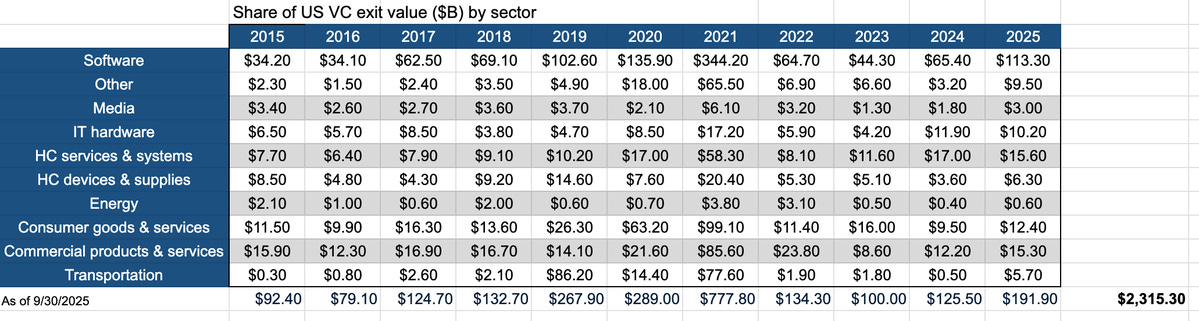
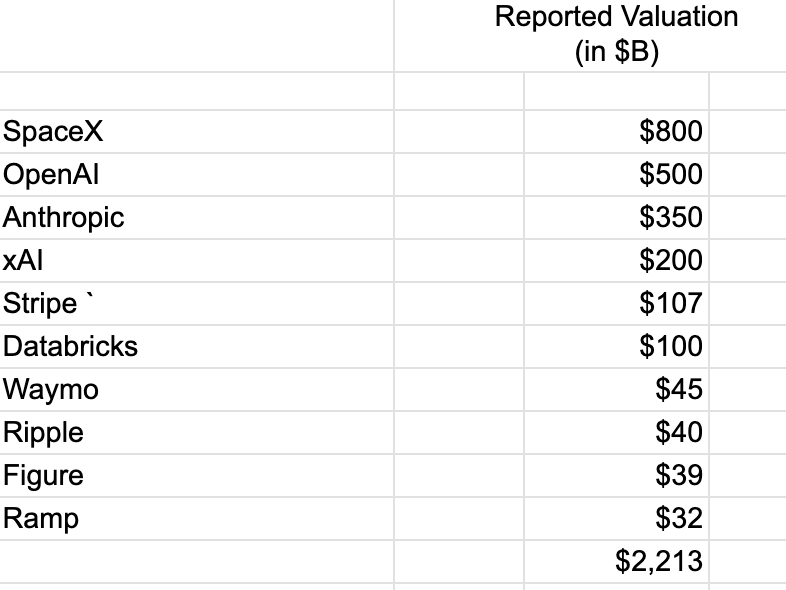
Putting it another way, the top 10 private US-based companies have already created value equivalent to 95% of every exit over the last decade! While there clearly is a difference between a fundraising valuation and an exit valuation, the data still appear to strongly support the argument that we should expect the next decade to generate meaningfully more exit value than the last decade.
5. What Actually Went Public in 2025
Across datasets, the same pattern emerges:
Characteristics of 2025 IPOs:
Concentrated in the $5B–$15B+ valuation range
Weighted heavily toward AI infrastructure or AI-adjacent companies
Very few mid-cap VC-backed IPOs
SaaS names generally pricing below their last private round
Mixed aftermarket performance outside AI, with some AI listings benefiting from intentionally conservative pricing
This is less a temporary dislocation and more an allocation preference.
Does size matter?
Evidence from IPO issuance data and equity capital markets commentary suggests investor demand in 2025 has skewed toward larger offerings, where liquidity, float, and index eligibility are easier to achieve. As a result, many mid-scale companies—despite solid fundamentals—appear to be navigating a narrower set of viable exit paths between M&A and IPOs.
What didn’t go public — and why it’s harder to measure
There is limited transparent data on companies that prepared for IPOs but paused or pulled transactions. Much of this activity happens through confidential filings or never becomes public.
However, feedback from bankers and investors points to common blockers: insufficient scale, valuation gaps versus public markets, limited institutional sponsorship, and sector exposure without a clear structural growth narrative.
Alternative liquidity paths
For companies that didn’t list, liquidity often shifted to less visible channels: strategic M&A, private equity takeouts, continuation vehicles, and secondary transactions.
The takeaway: the IPO market isn’t closed — but size, structure, and expectations increasingly determine who can access it.
6. What This Means for VCs, LPs, and Founders
For VCs
Hold periods for non-AI and mid-cap companies are extending.
SaaS-heavy portfolios may need recalibration or rely on continuation vehicles.
Secondaries and tenders continue to be core liquidity levers.
For LPs
DPI recovery is paced by large-cap IPOs, not broad-based activity.
The late-stage AI pipeline is deepening, but remains concentrated.
For Founders (Reset Your Expectations)
Companies priced below $3B during 2021–2022 may require valuation resets.
If you’re not ready to reset, consider alternative financing paths / profitability.
Public markets are rewarding efficiency, not narratives — AI must show measurable leverage.
7. Where the Market Goes in 2026
If macro conditions stay roughly on their current path, expect:
Mega-IPO’s steal the show in 2026 (SpaceX @ $1.5T, OpenAI @ $500B, ByteDance @ $480B, Anthropic @ $183B, Databricks @ $134B)
Continued bifurcation between AI mega-caps and the broader software market
Gradual expansion of the late-stage IPO pipeline
Increased private equity participation for non-AI, mid-cap, or slower-growth companies
The bottom line:
The IPO market isn’t closed — it’s filtered.
And the filter appears structural, not cyclical.
Sources:
That’s all for today folks! Thanks for your support and spreading the word! Share this on Twitter or LinkedIn to help grow “the crew!”
Every Tuesday/Thursday, we publish VC/CFO insights that matter - highlights from notable VC GPs, LPs, and CFOs/finance pros. Check out our VC Fund Playbooks, Models, Budgets, & Compliance Checklists @ AirstreamAlpha Products!
Need more help? Check out Fund CFO Support provided by the Airstream Alpha Team.
Love what we’re doing? Consider upgrading to paid for deeper dives on Thursdays (most paid subscribers expense these insights!). Top recent posts: