

It’s quarterly valuation & audit time again — dashboards open, KPIs refreshed, comps updated, and valuation memos circulating. Compared to the earlier part of the year, Q4 brings its own rhythm: year-end audits approaching, LP updates underway, and a natural moment to revisit how your valuation process is working.
This isn’t new territory; we covered mechanics and frameworks in earlier valuation notes:
What follows is a grounded walkthrough of what we typically see in Q4, where teams tend to focus, and how to approach valuations with clarity and consistency — without implying that one method or policy fits all situations.
Brought to you by:
Visible - No more chasing founders or wrangling spreadsheets. Finance teams at top VC firms use Visible’s AI-driven platform to streamline portfolio monitoring, stay audit-ready, and impress LPs. Find out why our customers love us today.
AngelList - As VC firms scale their institutional LP base, finance is no longer just back-office hygiene—it’s a strategic advantage. AngelList’s fund admin operates like an outsourced COO, streamlining operations, meeting institutional diligence standards, and delivering timely, accurate reporting. See why 25k funds and syndicates trust AngelList.
1. The fundamentals haven’t changed — just the focus
Quarter-end valuations are still centered on fair value. But Q4 often adds additional layers:
Internal teams take a closer look at assumptions heading into year-end.
LPs tend to ask more questions as annual reports approach.
Audit prep pushes teams to clean up documentation and method choices.
None of this suggests valuations should lean more conservative or aggressive.
It simply means clarity and support matter more in Q4 because downstream stakeholders are paying closer attention.
2. What we typically highlight with fund managers this time of year
Across our historical posts, a few recurring themes show up every Q4:
Calibration still matters
As we noted in #230, valuations grounded in last financing rounds still require calibration. Q4 is a good time to revisit how those assumptions have evolved through the year.
Method selection should be intentional
We’ve talked about using a toolbox of approaches — not because more methods equal better marks, but because different situations call for different techniques.
Documentation quality increases in importance
Q4 is the setup for audit season. Teams that invest in tighter memos now reduce back-and-forth later.
This includes:
method rationale
KPI changes
assumptions and sensitivities
a simple plain-English narrative
Consistency across the portfolio
A recurring theme from prior posts: consistency doesn’t mean uniformity — it means similar facts lead to similarly reasoned approaches.
3. A simple execution checklist (Q4 edition)
A balanced, CFO style list — no hype, just practical signals:
Revisit calibration with a clean lens.
Double-check that method choice fits the company’s stage and structure.
Update comps or alternative approaches as needed.
Add a short rationale for any adjustments or changes.
Ensure QVPs (if you use them) are complete and consistent.
Write your narrative like someone will read it six months from now and need to understand what happened.
The goal isn’t precision — it’s repeatability and clarity.
4. What to focus on heading into year-end
Based on how we’ve framed this across #207, #230, and #254, most valuation questions fall into similar buckets:
Why this method?
What changed compared to last quarter?
How did you think about uncertainty?
What’s the logic behind any adjustments?
How consistent is this approach across the portfolio?
Auditors & LPs rarely challenge a number outright but want to understand the supporting process.
🗂 Not Our First Rodeo: Historical Posts to Reference
If you’re building or refining a valuation policy — or preparing for LP questions — these posts lay the groundwork:
Q4 is a good time to revisit these — not because you need a new philosophy, but because year-end highlights the value of intentional, consistent, well-explained process.
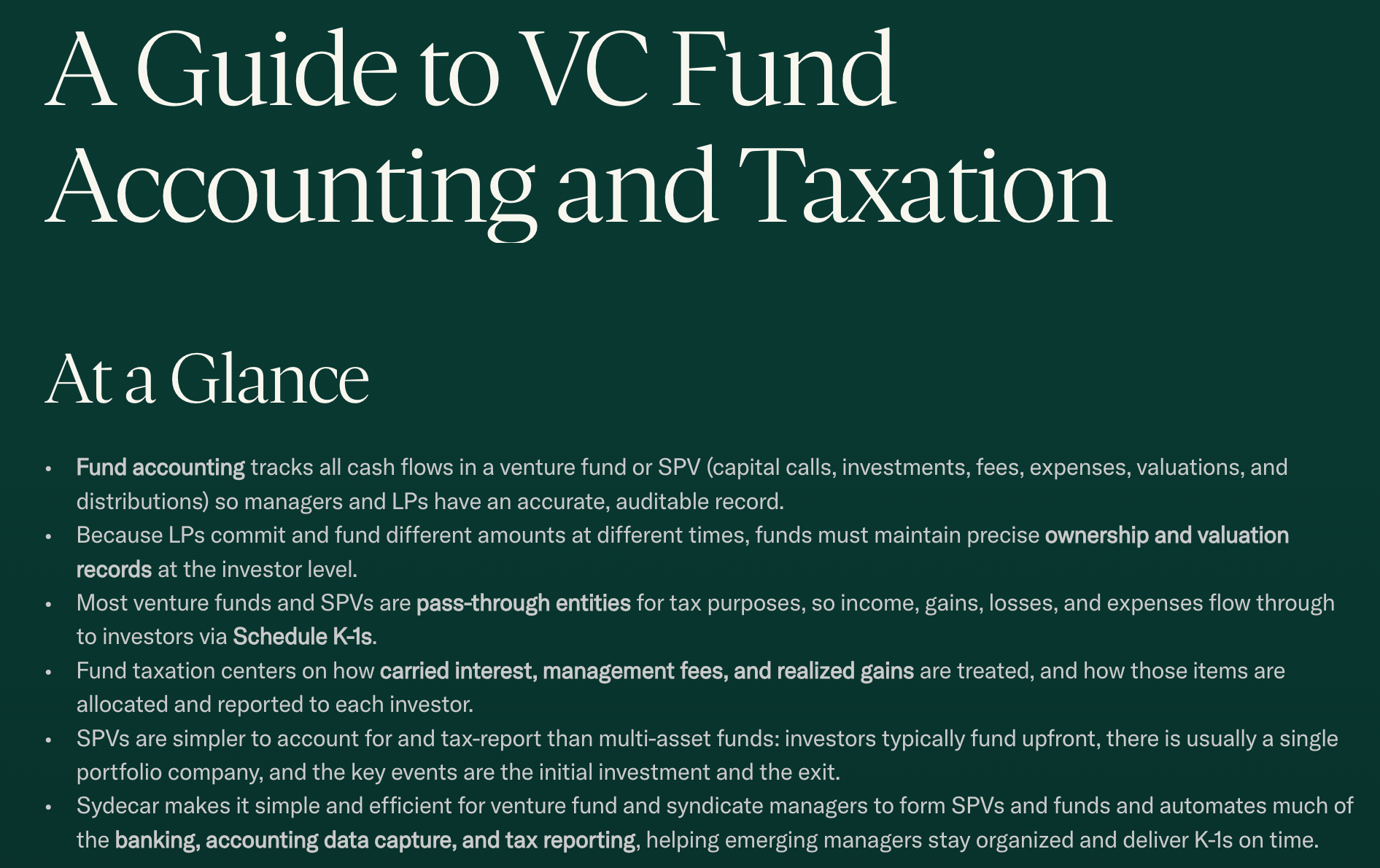
📘 Related Resource: A Guide to VC Fund Accounting & Taxation
Valuation is just one part of a fund’s financial workflow. If you’re also thinking about closing the books, preparing K-1s, or managing SPVs, this quick guide may be useful: Sydecar: A Guide to Fund Taxation (incl. valuation context)
5. Closing thought: Q4 isn’t about reinvention — it’s about reinforcement
Quarterly marks don’t have to be perfect — but they do need to be thoughtful, supported, and internally coherent.
Q4 gives you a chance to tighten your process, clarify your assumptions, and set the tone heading into audit season. It’s less about new insights and more about reinforcing a process that holds up across time.
That’s all for today folks! Thanks for your support and spreading the word! Share this on Twitter or LinkedIn to help grow “the crew!”
Every Tuesday/Thursday, we publish VC/CFO insights that matter - highlights from notable VC GPs, LPs, and CFOs/finance pros. Check out our VC Fund Playbooks, Models, Budgets, & Compliance Checklists @ AirstreamAlpha Products!
Need more help? Check out Fund CFO Support provided by the Airstream Alpha Team.
Love what we’re doing? Consider upgrading to paid for deeper dives on Thursdays (most paid subscribers expense these insights!). Top recent posts:
Hey, interested in partnering with your newsletter. What's your email to reach out to?