

Early-stage venture has never felt more crowded. More firms. More capital. More noise. And with AI accelerating everything, bigger checks are flowing downstream — earlier and faster than ever before.
Beezer Clarkson (Sapphire Partners / OpenLP) recently spoke with Forerunner’s Founding Partner Kirsten Green to explore what a “healthy” venture market actually looks like — and backed it with a new analysis of 2,000+ priced Seed & Series A rounds from PitchBook.
A new analysis from Elizabeth “Beezer” Clarkson offers one of the clearest looks we’ve had at what’s actually happening under the surface.
Short answer: It’s not broken. It’s concentrated.
Brought to you by:
Visible - No more chasing founders or wrangling spreadsheets. Finance teams at top VC firms use Visible’s AI-driven platform to streamline portfolio monitoring, stay audit-ready, and impress LPs. Find out why our customers love us today.
AngelList - As VC firms scale their institutional LP base, finance is no longer just back-office hygiene—it’s a strategic advantage. AngelList’s fund admin operates like an outsourced COO, streamlining operations, meeting institutional diligence standards, and delivering timely, accurate reporting. See why 25k funds and syndicates trust AngelList.
The New Shape of Seed: Calm at the Bottom, Chaos at the Top
Roughly 90% of priced Seed rounds are still happening below $20M.
And in this zone, dedicated boutique Seed funds retain a clear edge.
Relationships still matter. Specialization still wins. And speed still beats size.
But once a Seed round crosses $20M, the dynamic flips fast:
Nearly 70% of $20M+ Seed rounds include a mega-fund as a lead or co-lead
These rounds represent only ~5% of total Seed activity
Yet they attract outsize attention, competition, and pricing pressure
In other words, the “crowded market” narrative isn’t wrong —
it’s just happening in a very small, very visible slice of Seed. That’s where the arms race lives.
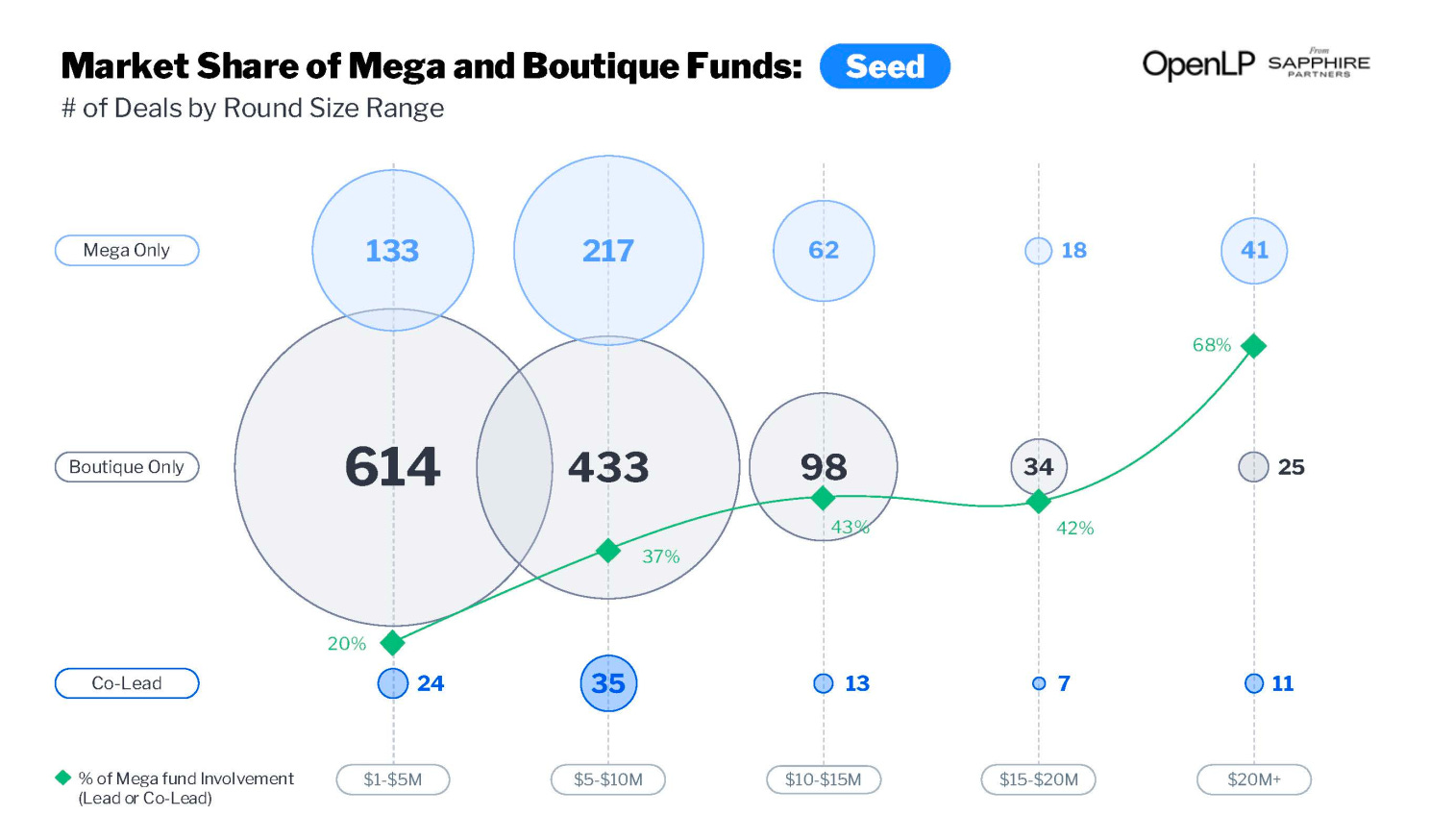
Seed: Who’s Actually Doing the Most Deals
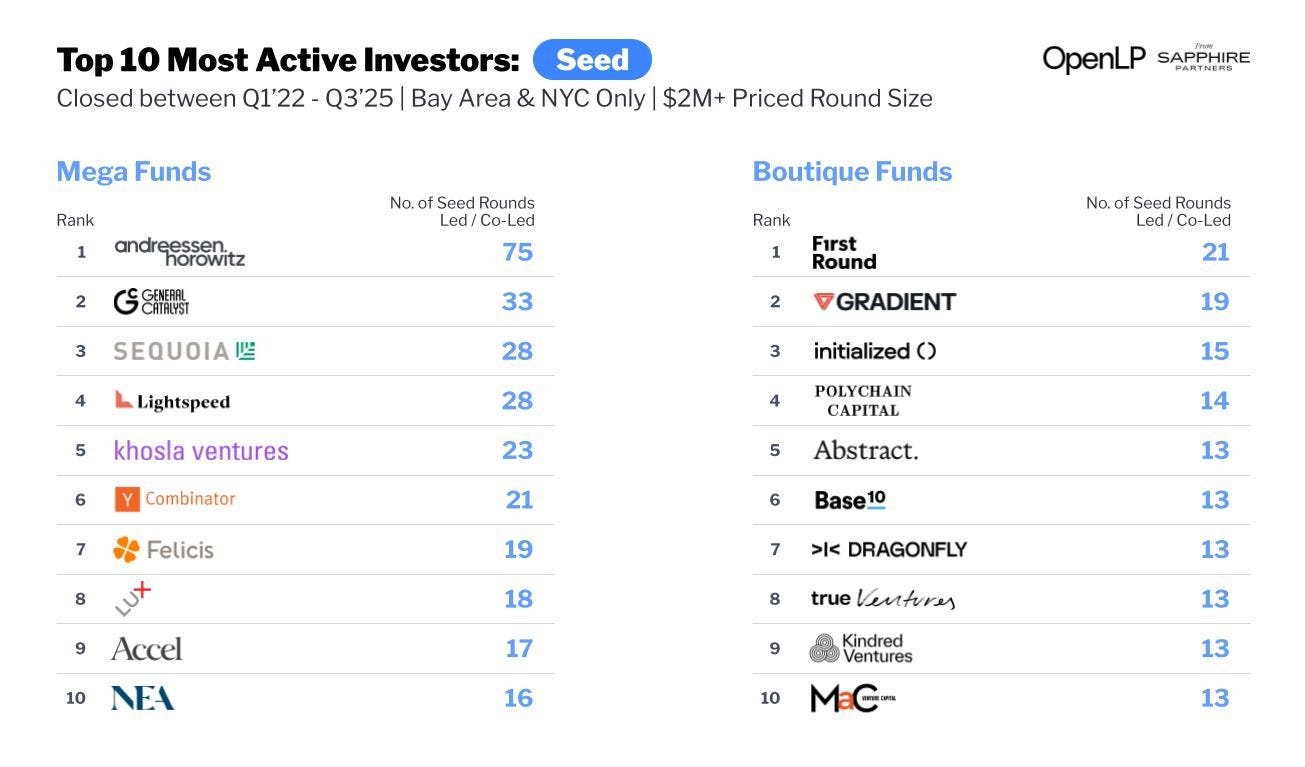
This reinforces the split: boutique seeds dominate the bottom / mid-range, while mega-funds show up aggressively at the highest-priced Seeds.
Series A: Where the Power Shift Gets Real
Series A tells an even clearer story.
Most activity still clusters around $20M, but that’s not where power is concentrated.
Below $20M: Boutique A funds lead the majority of rounds
Above $20M: Mega-funds begin to dominate
By $50M+, mega-funds are involved in ~75% of Series A rounds
Only about 40% of Series A rounds fall into the $20M+ buckets —
but that 40% is where:
Valuations jump
Mega-funds show up earliest
Boutiques compete with much larger balance sheets
It’s not an even playing field. But it’s a very clear one now.
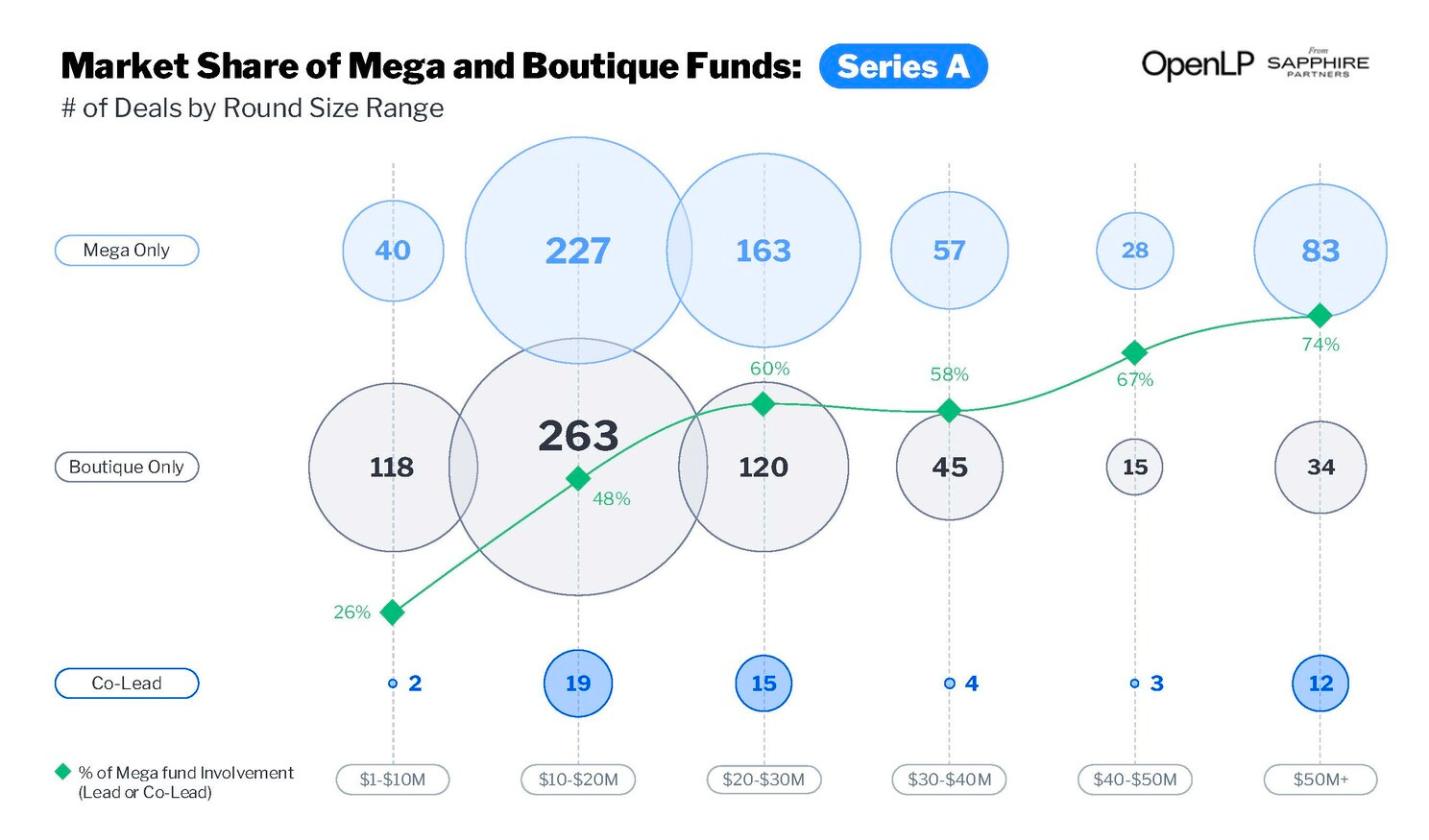
Series A: Who’s Leading the Charge
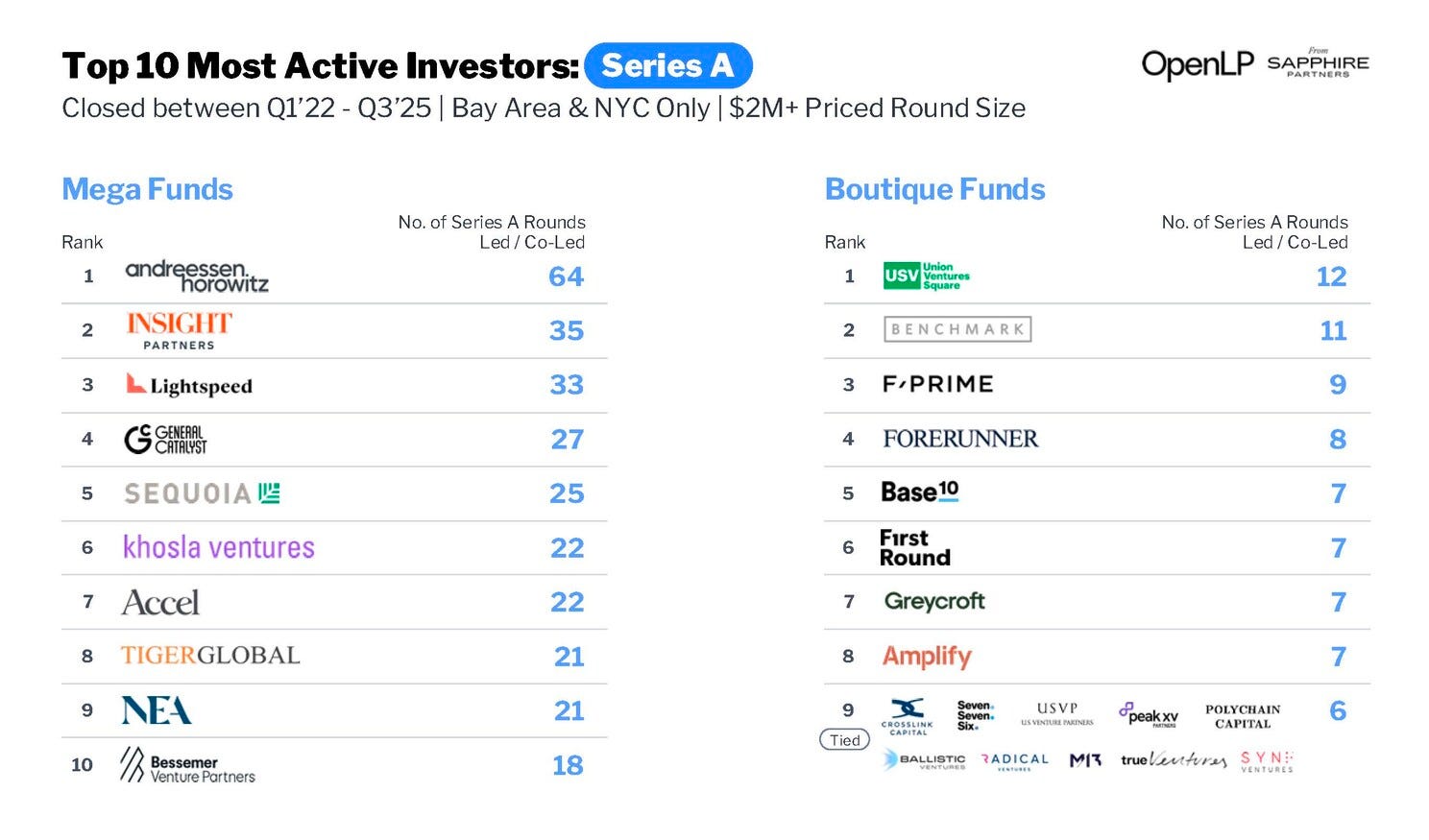
Another clean split: boutiques dominate the lower end, mega-funds dominate the upper end.
Seed vs. A Round - What’s The Difference?
As Kirsten Green (Forerunner) put it in her conversation with Beezer:
“I’ve lost track of the difference between a Seed and an A.”
And the data agrees.
Today’s round labels are less about stage and more about:
Traction
Market speed
Founder profile
Ambition
Narrative gravity
A $25M Seed now behaves like a traditional Series A.
A $50M Series A looks closer to a growth round from a decade ago.
This isn’t undisciplined.
It’s a structural reset in risk and scale.
So… Is This Market Actually Healthy?
Depends where you sit:
Founders with breakout momentum
→ Capital is abundant and competitive
Boutique funds
→ Lower and mid-range rounds are still your stronghold
Mega-funds
→ Earlier entry = bigger ownership + narrative leverage
LPs
→ The real question is:
Are you overpaying for velocity?
Or early enough for power-law outcomes?
As Kirsten put it:
“Rarely do we have reinvention and opportunity at the same time — certainly not at this scale.”
That doesn’t look like a broken market.
It looks like a market in transition —
with capital increasingly concentrated at the top end of Seed and Series A, and conviction becoming the new moat for both founders and investors.
Venture has always been competitive.
What’s changed is where that competition is most intense.
And now, we can finally see it clearly.
🎯 Tools to Navigate This Market More Clearly
Given how polarized Seed and Series A have become — with mega-funds concentrating at the upper end and boutiques holding the lower tiers — many GPs have been asking for clearer ways to pressure-test capital allocation, reserves strategy, pacing, and ownership math.
Below are a few tools we’ve built to help make those decisions sharper.
